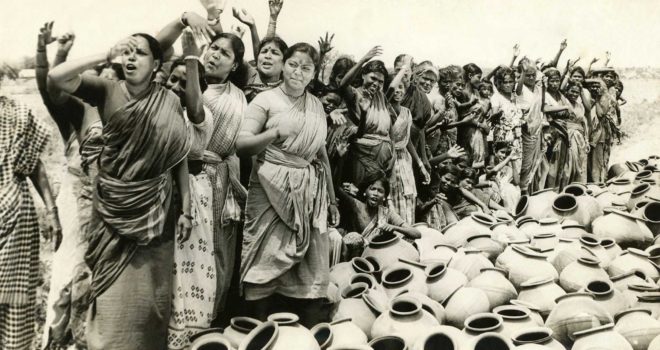
Director of more than 90 films in Tamil, Telugu and Hindi, K. Balachander (1930–2014) shaped several generations of audiences and introduced actors who would go on to become icons, including Kamal Haasan and Rajinikanth. Yet largely unknown in Europe, this major filmmaker is the subject of an unprecedented retrospective in France and across Europe, featuring several recently restored films. His popular cinema reflects the transformations of Indian society. Desire, women’s emancipation, family hierarchies and class differences run throughout his work, which renewed Tamil cinema while remaining firmly committed to reaching a wide audience.
Talk – Introduction to the Cinema of K. Balachander – Mon. 23 Nov., 1.30–2.30 pm, Le Cinématographe – Free admission
Read the editorial
Balachander has long been described as a filmmaker who made “women-centric films”, as the discoverer of superstars Kamal Haasan and Rajinikanth, as a man of theatre who switched to cinema as the chronicler of the Tamil middle class. All these definitions are correct. None of them is sufficient on its own. They denote doorways into a work whose breadth lies precisely in the fact that it has never ceased to open these doors one onto the other. For Balachander was not content with simply introducing new themes into popular cinema: he also worked on forms, rhythms and conventions so that social conflicts could become those of the films themselves.
He focused on middle-class issues because this was the world that he knew best. Large families, precarious employment, strained marriages: the Tamil middle class gives him a dramatic device in which everyone has to negotiate their place amongst others. A difference of language thwarts a love story; a woman supports her family alone; a water shortage reveals the workings of power; Carnatic music turns into a battleground of class conflict. Ordinary situations thus reveal social tensions without reducing them to theoretical concepts.
His theatre training nourished his taste for confrontation, for ensembles and spaces where no one can avoid the presence of others. Cinema, however, enabled him to vary distances, confront the spoken word with what it hides, use the face as the counterpoint to a scripted line. The dialogues are not limited to establishing positions: they modify power relationships, reconfigure alliances and can tip comedy into drama.
In his films, women are centre stage. They work, provide for their families, take decisions and make mistakes. Their autonomy comes up against material obligations, attachments and conventions: Balachander shows the price they pay for their freedom without setting them up as exemplary heroines.
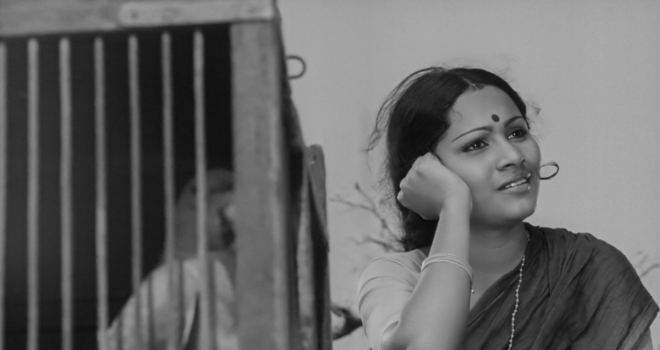
In Aval Oru Thodar Kathai (1974), Kavitha is the sole breadwinner providing for a family in which the men have shirked their responsibilities. She earns her living without enjoying a life of her own. The title, possibly translated as “She is a never-ending story”, lends the narrative its logic of accumulation: each responsibility triggers yet another, each chance of happiness comes with a new obligation. The film, which owes something to Ritwik Ghatak’s Meghe Dhaka Tara, does not portray Kavitha as a self-sacrificing saint. The repetition of tasks and renunciations ultimately highlights the impasse of a life that others rely on for their subsistence.
In Nizhal Nijamakirathu (1978), desires and power relationships upset the assigned roles, but behaviours are not reduced to moral lessons. Arangetram (1973) already denounced the respectability of a family demanding the sacrifice of one of its daughters; Avargal (1977) followed a divorced woman who refuses to accept that her story has ended. Balachander’s heroines are neither abstract symbols of emancipation nor figures destined for victory.
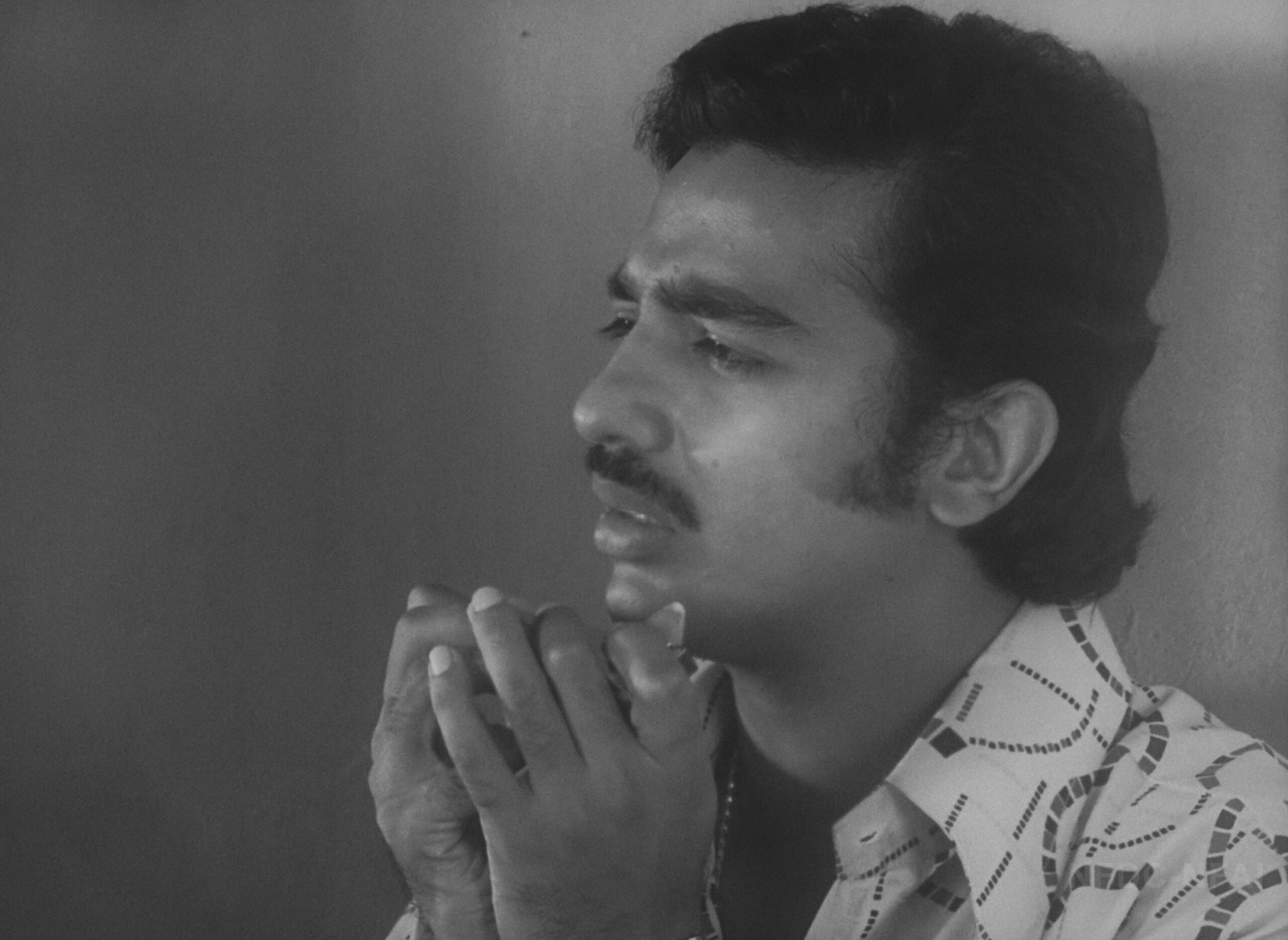
A freedom of tone is again found in Apoorva Raagangal (1975), where a young man loves an older woman, while the woman’s daughter falls in love the young man’s father. This romantic geometry disrupts the moral tenets of family order. The film also marks two beginnings: Kamal Haasan stands out as a singular actor, while Rajinikanth plays a supporting role. Balachander sees them as having further acting potential and also rehires Sujatha, Saritha, Sowcar Janaki, Sridevi, Jaya Prada, Srividya and Jayasudha. Stars do not only guarantee effectiveness: they become a material that the film transforms.
A to-ing and fro-ing between languages broadens this dimension. Balachander makes films in Tamil, Telugu, Kannada and Hindi; sometimes, he revisits his own stories to engage other audiences. Maro Charithra (1978) is a love story between a young Telegu woman and a Tamil man, which is undermined by their linguistic and family differences. Language dictates the distance between the lovers to the point of defining how those around them perceive their union. By directing the film’s Hindi version, Ek Duuje Ke Liye (1981), Balachander does not do away with this regional identity: he probes what it is in a story that resists the transfer from one language to another.
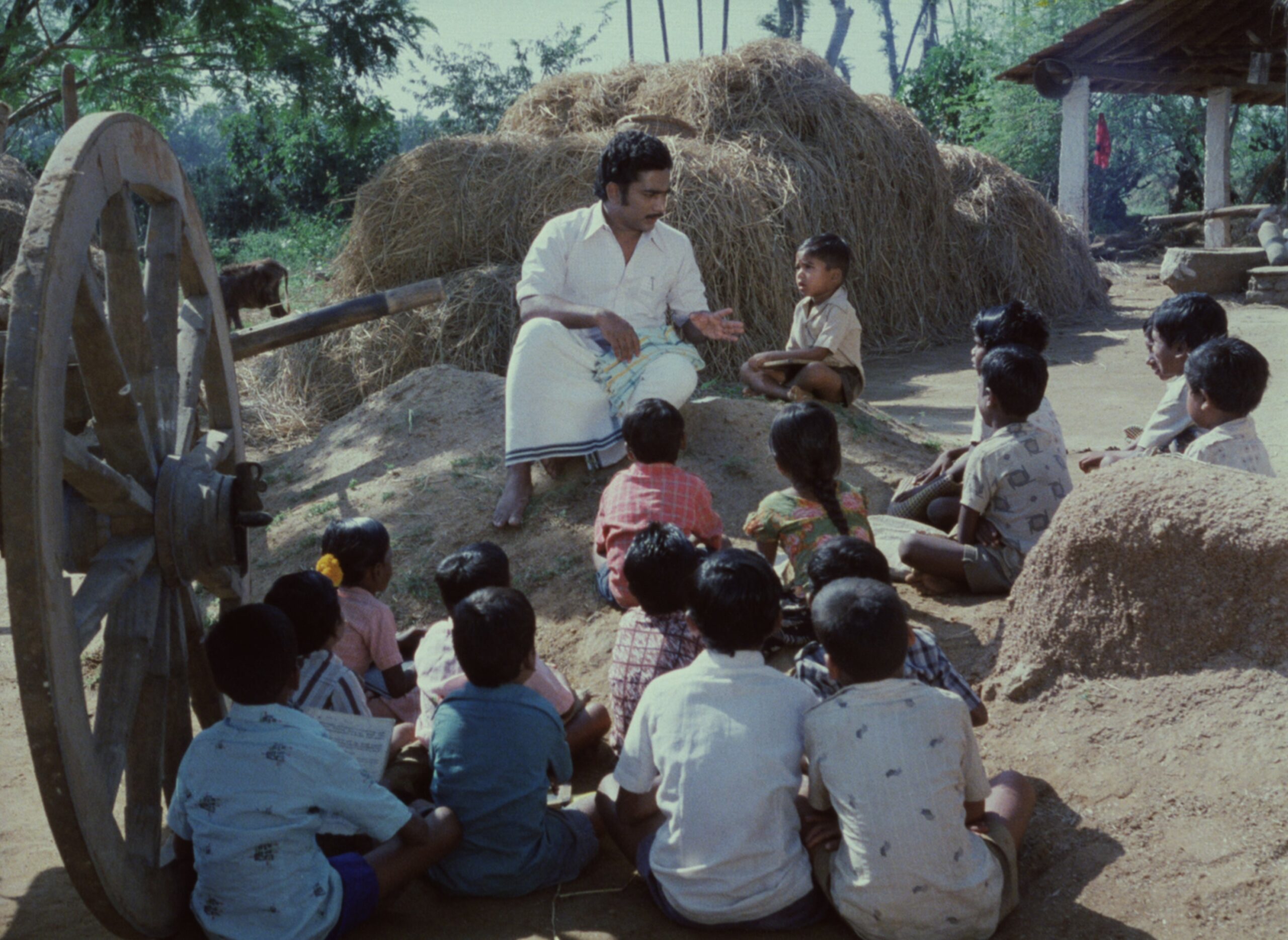
In Thanneer Thanneer (1981), the drama revolves around a basic necessity. In the drought-ridden village of Athipatti, the inhabitants attempt to organise their water supply on their own. Their initiative clashes with the local administration, its electoral interests and the scheming of political leaders. Based on the play by Komal Swaminathan, the film draws its strength from the imbalance between the simplicity of the need and the complexity of the obstacles opposing it. The scarcity of water dictates gestures and expectations; political bureaucracy pushes urgency into a deadlock. Water is not only the symbol of an injustice: it is a tangible manifestation of how powerlessness is fabricated.
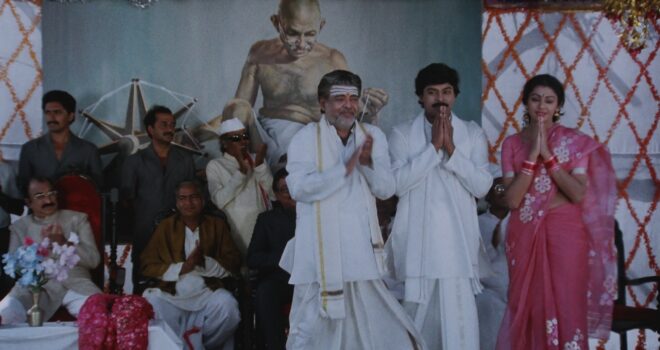
In Achamillai Achamillai (1984), political corruption worms its way into marital life. Velu, whose entanglement emerges when he rubs shoulders with power, gradually sacrifices his ideals to his ambitions. Thenmozhi refuses to resign herself to this change. They marry on 15th August, India’s Independence Day, which sets their story in the context of a national promise soon to be thwarted by the compromises of daily life. This electoral satire is charged with a tragic tension: the intrigues of public life blight their intimacy, revealing that political independence is not enough to put an end to relationships of domination.
In Varumayin Niram Sivappu (1980), three young men are looking for work, but their diplomas are not opening any doors. The film’s biting humour does not stifle its critical nature: it reveals the gap between promises made to young people and the opportunities they are actually given.
Carnatic music opens up another area of confrontation. In Sindhu Bhairavi (1985), renowned musician J. K. Balaganapathi finds his self-confidence shaken by Sindhu, who challenges the exclusivity of a jealously coded art. Who is the music meant for, given that only the initiated seem to be able to grasp its value? The first names of the title’s two female characters also denote the name of a Carnatic raga: the personal drama is thus interwoven with the musical material itself. The songs are neither intervals nor ornaments; they form part of the conflict and shift the issue of legitimacy towards the question of listening. But this cultural openness fails to dissipate power relationships: the emancipation promised by art is still riddled with the contradictions of a patriarchal system.
Rudra Veena (1988) revisits this questioning in a more directly political way. The son of a Carnatic music master refuses to separate the beauty of his art from the injustices that surround him. His conflict with his father confronts two notions of heritage: preserving the music from any outside impurity and introducing it to the world at the risk of altering its traditions. The aesthetic disagreement becomes a question about the artist’s place in society. Art does not lose its value when it confronts the real world: on the contrary, this is where it has to take a risk. While Sindhu Bhairavi calls into question the exclusion of some audiences, Rudra Veena challenges discarding a tradition in the face of injustices.
Balachander’s uniqueness lies in his work with commercial forms. He never turns his back on melodrama, song or romance to engage with a reputedly more serious cinema: he uses their conventions to create contradictions. A song shifts the meaning of a plot, a dialogue reveals a violence that is not evacuated by the dénouement, comedy brings to light social absurdity. Popular forms do not stifle thought: they produce it, with all its excesses and abrupt changes in tone.
Yet Balachander is not a reformer free from ambiguity. His films are caught up in the moral standards of their age and sometimes even re-establish the limits that they challenged. Women acquire marginal freedoms but do not always have the opportunity to explore the consequences; social criticism sometimes ends up in a moral lesson. The gap between the boldness of the subjects and the limits of their resolution is an integral part of his œuvre.
His place eludes simple classification. Thanneer Thanneer and Achamillai Achamillai resonate with various concerns of the New Indian Cinema, while the songs, stars and impassioned storylines anchor it in popular Tamil cinema. Reducing it to mainstream cinema or likening it to parallel cinema would be overly simplistic: his films bring into close contact forms that the history of cinema has often kept apart.
Balachander’s influence is not limited to the actors he discovered or the diversity of his subjects but also lies in the way he embeds social contradictions into the mechanisms of the narrative: family responsibilities become a prison, language puts the sense of belonging to the test, a shortage reveals the inner workings of bureaucracy, music questions the transmission of knowledge.
Balachander links collective structures to the decisions that determine whether the characters accept, sidestep or challenge social rules. This means that popular cinema becomes a place where entertainment and social inquiry mutually transform each other. Melodrama, song, comedy and family clashes retain all their emotional power whilst also providing the means for a critical interpretation of the world. Within this tension comes the uniqueness of a major œuvre of Tamil cinema and a decisive contribution to the history of Indian cinema. Hadn’t he been nicknamed Iyakkunar Sigaraml, the filmmaker at the top.
Jérôme Baron