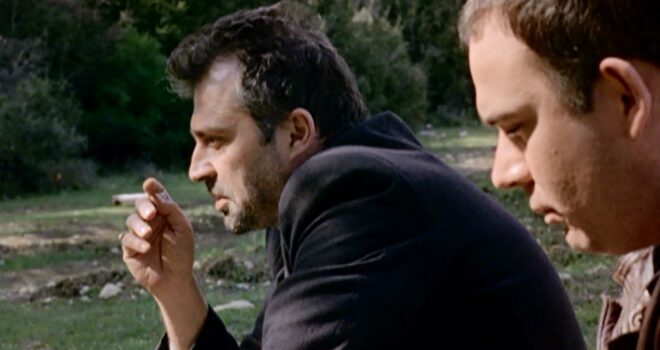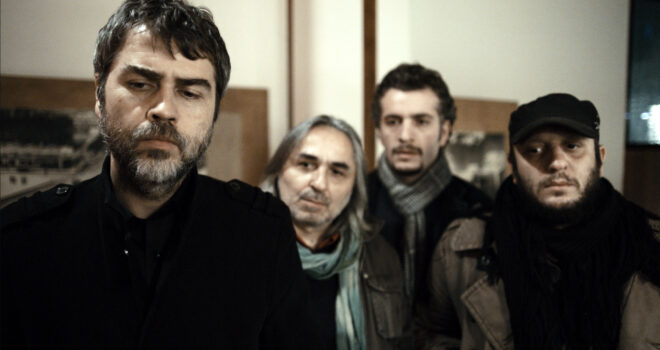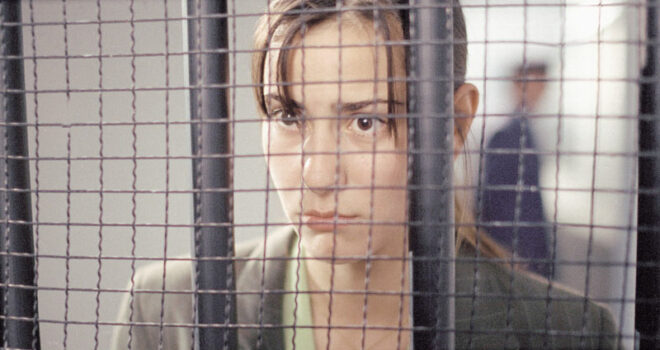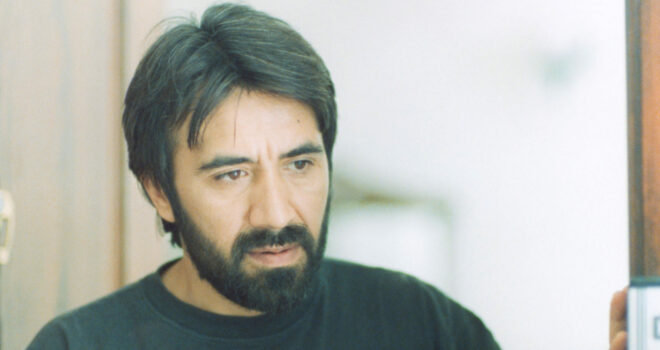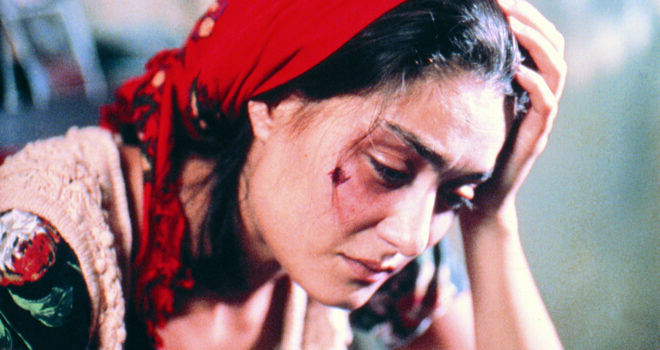
A major figure in contemporary Turkish cinema, Zeki Demirkubuz (born 1964) is the subject of the first complete European retrospective of his work, from C Blok (1994) to Hayat (Life) (2023). Nearly thirty years of filmmaking in which human relationships, jealousy, guilt, loneliness and power dynamics reveal the contradictions of a society. A guest of the Festival des 3 Continents, the filmmaker will be in Nantes to present this retrospective.
Meeting with Zeki Dermikubuz Sun. 22 Nov., 11 am–12.30 pm, Le Cinématographe – Free admission
Read the editorial
In Zeki Demirkubuz’s films, the stories seem to begin through the prism of their own hindsight. They open onto a world where nothing yet seems bound to happen, but where something has already taken place, something of which the characters little by little discover they are the custodians. A man is sitting in a room, a woman is waiting, a telephone rings, a door opens, someone returns sooner than expected. The characters don’t really enter a story, they are already inside it. Something has coalesced before the opening shot and the film is less about how they are going to get out of the story than seeing what it will cost them to try to do so. Hence, this impression of fatality, which is not to be confused with fatalism. In the Turkish director’s work, destiny is not some higher power that decides in place of the individual. It is more like a name you give to a decision when you have already forgotten that it was one.
This is why Demirkubuz’s twelve films convey less a feeling of a trajectory than that of a story which, from film to film, returns differently with a change of characters. C Blok (1994), Innocence (1997), Third Page (1999), Fate (2001), Confession (2001), The Waiting Room (2003), Destiny (2006), Envy (2009), Inside (2012), Nausea (2015), Ember (2016) and Life (2023) use the same materials — desire, jealously, shame, money, solitude, debt, spoken words — as if they were waiting for other lives in order to resume their work. A situation seems to return but never happens twice in the same place or to the same people. The films depend perhaps on these shifts: putting the same passions into other hands, locking them in other rooms and discovering that they never cause exactly the same damage. Apartments, hotel rooms, kitchens, offices, stairwells, cafés, thresholds: Istanbul resembles city without a panorama, with almost no outside. We enter someone’s home, we leave it too late, we wait in a corridor, we hear a voice behind a door. The city becomes the tangible geography of the incalculable distances between people — and these distances are seldom innocent.
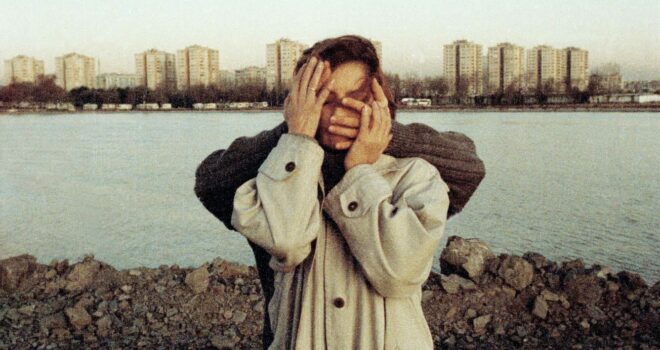
Right from the outset, C Blok makes them a matter of looking. Tulay watches her neighbour, suspects him, desires him; she then crosses the limits of her apartment as well as those of the place assigned to her. In this debut film, Demirkubuz experiments the powers of cinema with obvious delight: camera movements, emphatic compositions, music, zealously scripted dialogues. Less a youthful folly to be corrected than the pleasure of a filmmaker discovering his resources and testing them out. Years later, he himself was to recognise the impatience of these early days. Yet the film already holds an intuition that will never leave him: looking does not mean staying in one’s place. Tulay’s gaze introduces a dissymmetry into the space, brings closer what should have remained separate, blurs distances and finally displaces bodies and the narrative.
Innocence seems to have forgotten that a camera may want to be noticed. The shots are established, bodies speak, wait, tell their story. Yet this starkness creates a magnificent narrative machine. Bekir talks about Ugur, about Zagor, about himself and his story not only reports the facts but infuses them with a sense of necessity. He manufactures in hindsight what resembles a destiny. The more Bekir recounts his life, the more he seems to become its victim. His monologue gives shape to his obsession, but this shape imprisons him. As for Ugur, she has no time to transform her life into a story. She works, travels, protects her son, looks for Zagor, returns, sets off again. Bekir can turn his love into a legend; Uğur has to continue her route with what is left of it. Fate then has the almost insolent idea of going back to before the narrative begins. The film depicts Bekir before he knew how to tell his story and shows how this destiny was fabricated, decision after decision, with much less grandeur than seemed to be the case in Innocence. The young man does not encounter his destiny; he builds it choice after choice, renunciation after renunciation. And while Ugur extricates herself from what Bekir’s narrative has made of her, she nonetheless remains trapped in a story that is not wholly her own. The Fate / Innocence diptych is thus less a story told twice and more like a little machine for disassembling the very idea of fate. In the first film, we see the gestures that fabricate it; in the second, we hear the voice that, in hindsight, makes them seem ineluctable. Demirkubuz refrains from asking which of the two versions is true. He shows something more disturbing: we often need to talk about our choices as if they happened to us.
Third Page shifts this question towards people with much less latitude to turn their life into a novel. Isa and Meryem live in a world where the rent, a debt, a landlord, a gun or a door opened at the wrong moment can be enough to upend an existence. The title points to lives that have no story, where only a news item will snatch them from anonymity. For Isa, Meryem is a possible escape route, but also a projection: he sees in her a way-out because he needs one. Yet the film avoids turning love into an escape. Although desire sometimes opens a door, there is no guarantee that they can go through it. The characters have wants, but these are never in a void. Money, housing, work, family and desire constantly remind them that wanting is not sufficient: circumstances are also a determining factor.
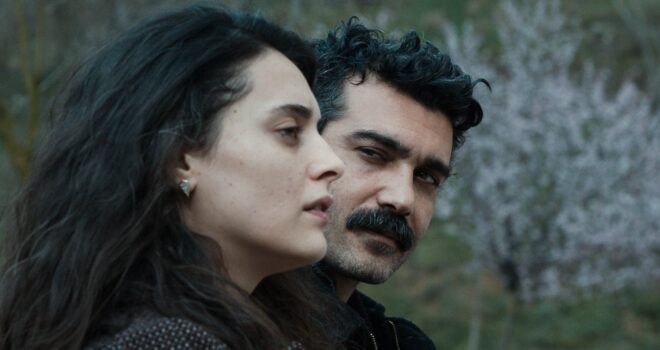
Ember delivers a particularly barren version of this. Emine has to provide for her child whilst her husband is abroad. Ziya, his former employer, helps her out financially. Then the husband returns and the nature of this assistance changes and becomes a debt – the debt raises suspicion, the suspicion becomes an abyss. The amount is the same but takes on a different meaning. In Demirkubuz’s films, money rarely circulates alone. Freedom is not an abstract room where everyone can move around at will; it has a price, an address, debts, bodies that depend on each other. Ember drives this logic to the heights of asceticism. Emine belongs to this gallery of women who we might wrongly reduce to the role assigned to them in the masculine narrative. Tülay was watching; Ugur refused to let herself be entirely trapped by the narrative; Seniha, in Envy, is also watching but with a lucidity poisoned by the feeling she has been wronged. Her brother is good-looking, she is not; without asking, he receives what she has been deprived of: desire, attention, the promise of a place among others. She prefers to study the mechanisms of this injustice. Her jealousy becomes a science of human preferences; sometimes one only needs to understand why others are loved in order to worm one’s way into their happiness.
Elsewhere, this mechanism becomes one of language. Confession is a film where a question is so often repeated that it finally takes the place of the answer. Harun knows that his wife has cheated on him, but he needs to hear her say it, as if the fact could only be completely true if he hears it from her mouth. Soon what he is seeking is no longer to know but to force the other to recognise the world as he sees it. Harun wants this confession as the ultimate form of possession. The more he demands it, the more she is clearly drifting away from him.
Destiny takes the opposite stance to Confession. Musa demands nothing. He even seems to have decided to stop deciding anything. This very free adaptation of Camus’ The Outsider gives an almost theoretical form to a question that is still waiting in the lobby of Demirkubuz’s films: if destiny is what remains of our acts, what does it become when a man is trying hard to cease acting? His mother’s death fails to trigger the expected reaction; he agrees to a marriage without desire; accused of a murder he did not commit, he apparently feels no need to defend himself. Musa does not struggle against his destiny; he gives it a free hand.
Inside creates the illusion of mastery for a man who believes he possesses it. Muharrem talks, judges, anticipates; he attends a dinner with former pals and methodically steers the evening towards humiliation, fabricating a scene that will prove his judgement of others right. Turkan, his cleaning woman, reveals the flipside of this freedom. Muharrem has all his time, his money and a social distance allowing him to transform every grudge into a personal matter. For Türkan, time is for sale, money counts, and dependencies are negotiated from one day to the next. For one, existence can become a problem to be interpreted; for the other, life imposes conditions upfront.
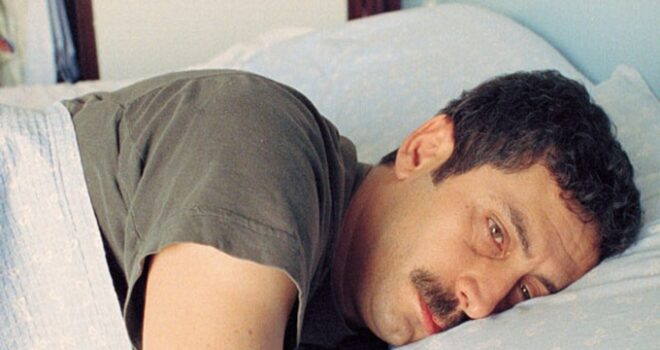
The Waiting Room had already brought Demirkubuz face to face with this problem. Ahmet wants to adapt Crime and Punishment, a novel in which a thought ultimately becomes an action. Yet Ahmet is not even capable of starting his film. He talks, projects, comments, postpones. Everything is there except the gesture that would convey an idea to the world. The waiting room of the title designates less a place than a state of mind where one can endlessly prepare something one is not going to do. In Nausea, this suspension becomes almost a generalised state. Ahmet, a well-off professor, loses his wife and daughter but continues to live as if nothing could really interrupt the course of his existence. He is an extension of Musa and Muharrem but in a different way: the same withdrawal from the world, the same self-awareness, but devoid of the argumentative energy that infuses some life into the other two. Whereas Muharrem transforms his contradiction into discourse, Ahmet has scarcely no need to justify himself. His inner world itself seems to have stopped producing events.
This is why Hayat (Life) arrives less like a new story than like an abrupt change of direction. Hicran flees the marriage forced upon her; Riza sets out to find her. This reaction could be that of another Bekir: a man convinced that his desire is reason enough to pursue a woman who is eluding him. But Demirkubuz revises his proposition. Hicran is not the mystery that Riza must disentangle. Her refusal is an action. Her flight has no need to be interpreted to become legitimate. Then comes the television. Hicran and her mother are watching Destiny. This might appear inconsequential: Demirkubuz’s latest film watches an earlier film by Demirkubuz. In fact, it might well be more telling. The story of Bekir and Ugur, as portrayed in Fate then transformed into a narrative in Innocence, returns here as a fiction watched by Hicran. It no longer embodies someone’s destiny but has now become an image on the television screen in someone else’s living room. And Hicran watches this story while she herself is being chased by a man. What Bekir had experienced as a definitive story suddenly appears as simply one scenario among many. Hicran can recognise something of her present in Destiny without having to reproduce its denouement. Recognising a story does not mean having to reenact it.
Recognising a story does not mean having to reenact it.
The film’s final movement, that of entering the tunnel, leaves this possibility open. It resolves nothing; it holds together flight and return, dream and reality, the hope of a way-out and the possibility of a new beginning. The Demirkubuz’s endings are rarely polite enough to close the doors that he spent two hours trying to open. Often, they remain ajar, just open enough to let in what happens after the film.
Here is where the great philosophical problem encounters something far more down-to-earth: freedom may be a metaphysical question, but it is also very pragmatically a matter of having to pay the rent.
Film after film, a story, but never quite the same. Seniha’s jealousy is not Harun’s; Bekir’s passion is not Riza’s; Musa’s indifference is not Ahmet’s; Hicran’s escape is not Ugur’s. What is repeated is not the scenario. It is the moment when self-representation becomes a line of conduct, then the moment that this conduct ends up fabricating what the character comes to consider as their own story. And these stories experienced as a fatality can then become again what they really are; simply stories.
Jérôme Baron